
The role of RFID middleware is to act as a software layer that sits between the RFID hardware (readers, antennas, and tags) and the business applications or systems. It facilitates the integration, management, and processing of RFID data, making it easier to leverage the benefits of RFID technology in various applications.
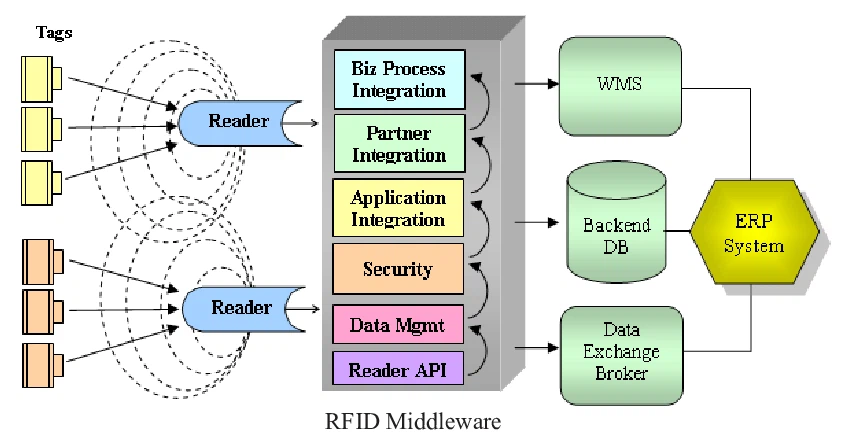
Here are the key roles and functions of RFID middleware:
- Hardware Abstraction: RFID middleware provides a standardized interface to communicate with different RFID hardware components. It abstracts the complexities of various hardware devices and protocols, allowing business applications to interact with RFID systems in a consistent and vendor-agnostic manner. This abstraction layer simplifies the integration process and provides flexibility in choosing and changing RFID hardware components.
- Data Collection and Filtering: RFID middleware captures and filters RFID data from readers, including tag reads, sensor data, and event triggers. It aggregates data from multiple readers and filters out irrelevant or duplicate reads, ensuring that only accurate and meaningful data is passed on to the business applications. Data filtering and normalization capabilities help improve the quality and relevance of RFID data for further processing.
- Data Transformation and Enrichment: Middleware can perform data transformation tasks, converting raw RFID data into a standardized format that is compatible with existing business systems or applications. It can enrich RFID data by adding additional contextual information, such as time stamps, location data, or business-specific metadata. This transformation and enrichment process helps to make RFID data more meaningful and actionable for downstream applications.
- Event Management and Notifications: RFID middleware enables the definition and management of events and triggers based on RFID data. It can generate real-time notifications, alerts, or triggers based on predefined rules or business logic. For example, it can trigger an alert when a specific tag is detected in a restricted area or send notifications when inventory levels reach a certain threshold. This functionality allows businesses to respond quickly to events and take proactive actions.
- Integration with Business Applications: One of the key roles of RFID middleware is to seamlessly integrate RFID data with existing business applications or systems, such as enterprise resource planning (ERP), warehouse management systems (WMS), or inventory management systems. Middleware provides APIs, web services, or connectors that facilitate the bidirectional exchange of data between RFID systems and business applications, enabling real-time visibility and automation of business processes.
- Analytics and Reporting: RFID middleware often includes analytical and reporting capabilities. It can generate reports, dashboards, or visualizations based on RFID data, allowing users to gain insights into operations, track key performance indicators (KPIs), and make data-driven decisions. Analytics and reporting features help organizations optimize processes, improve efficiency, and identify trends or anomalies in RFID data.
By fulfilling these roles, RFID middleware simplifies the integration of RFID technology into existing IT infrastructures, enhances data quality, and enables efficient and effective utilization of RFID data in a wide range of applications, including supply chain management, inventory control, asset tracking, and more.